May Review
- Samantha Gross
- May 30, 2018
- 9 min read
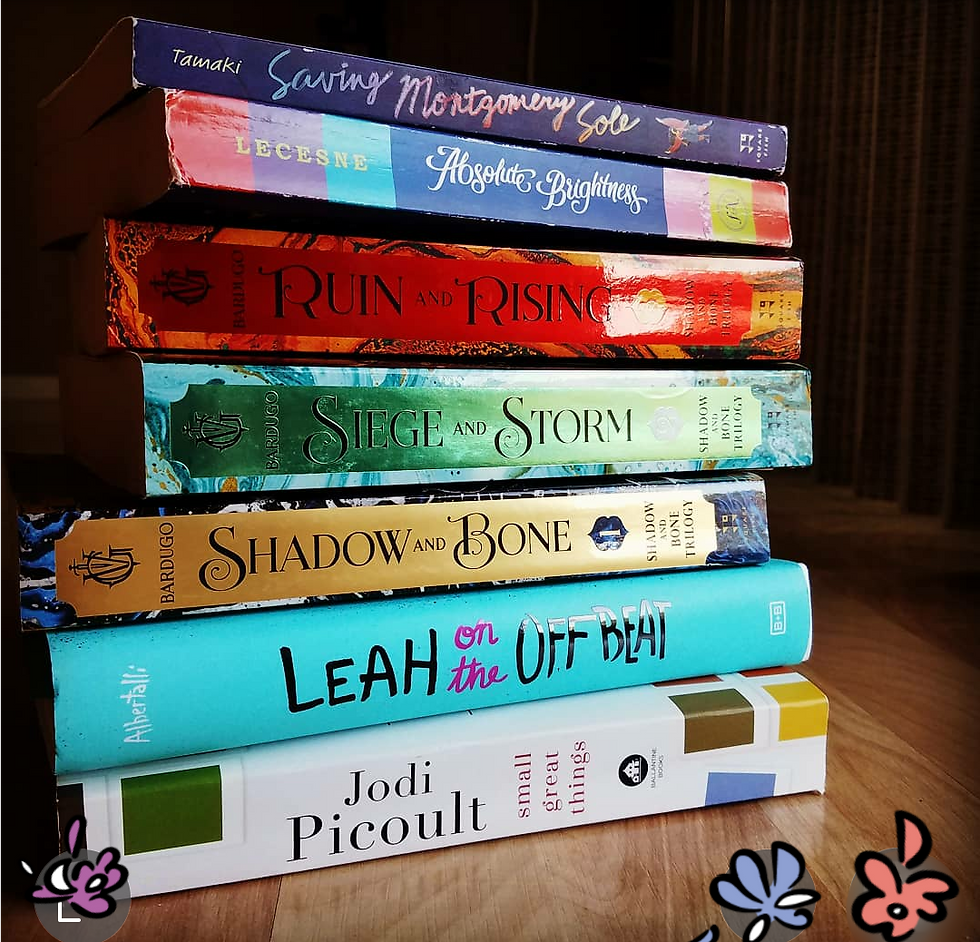
May was kind of a wild month for me. I decided to quit my jobs and take the time to travel a little bit, so next month might be a little short on books, although I guess that depends on how much time I spend on a plane or a train.
This past month I also spent more time reading than breathing, hence how I somehow managed to read seven different novels, the majority of which were much closer to 300 pages than 200, in the span of thirty one days. Hopefully my review of them won't be that long, but I make no promises.
Let's get cracking.
I ended April and began May was Jodi Picoult's most recent book, Small Great Things. Jodi Picoult has been a long time favorite of mine, and I've gotten to the point in my reading life where I've read almost all of her books. And she's got a lot of them. If anybody asked, I'd tell them my favorite was Leaving Time. And while that's still true, Small Great Things struck a chord in me, one that's more important than ever in today's political atmosphere. It took me a while to get through, but that was because I wanted to take my time with this four-hundred-page book, to make sure the lesson stuck and stuck well.
Small Great Things is about a black nurse named Ruth Jefferson, who works as a labor and delivery nurse. She spent the last twenty years doing the best damn job she can to help other people have babies so that her son Edison can continue to succeed. Small Great Things is about a white supremacist named Turk Baur, whose son Davis is born at the hospital where Ruth works, and who wants Ruth to stay as far away from him as possible. Small Great Things is about Kennedy McQuarrie, the defense attorney that takes Ruth's case when baby Davis Baur dies and his father decides it was Ruth's fault because she wasn't allowed to touch the baby.
Small Great Things is about what it means to recognize racism in a world where most white people don't even have to think about it. It's about facing injustice and recognizing that, yes, sometimes it's root cause is racism, and the best way to face that is to look at it headlong, no matter how uncomfortable it makes us white people to see the way we benefit from the suffering of people of color. Because our discomfort has nothing on what it means to be black in a white world.
Because Jodi Picoult is white, I had doubts that this book could do everything she set out to do with it. But in the end, I realized that Picoult wasn't trying to present an example of what injustices people of color face (even though she painted a pretty fine picture). No, Picoult wrote this book to show white people, like Kennedy, that you don't have to wear a swastika or a Confederate flag to be racist. It's inherent in how society treats people, how privilege is so ingrained in our every day lives that we can't even see the damage it does to people who aren't us.
Picoult is a master of words and storytelling. Her use of extended metaphor and beautiful descriptions are unmatched by any author I have ever read. And she researches the hell out of her topics before she even thinks about taking on a story. I always learn something from her novels, whether it's about elephants, the Amish, the Holocaust, or wolves. I put down every book she's written knowing I learned a lot, that entertainment is the best way to teach the masses. With Small Great Things, it felt like Picoult sat down to educate herself and dragged the rest of us along for the ride. It was a ride that was difficult at times, a ride that made me want to pound my fists and scream "this isn't fair!!!" But it was worth it. Every single word was worth it. So if you take nothing from this list, if you take nothing from any of my lists ever, take Small Great Things.
(This is my longest review, I promise)

The follow up to Picoult was Becky Albertalli's novel Leah on the Off Beat. And as far as Albertalli books go, I liked it better than The Upside of Unrequited, but not as much as Simon Vs The Homo Sapien's Agenda.
Leah surpassed my expectations for a Simon sequel. I went into it with only a vague idea of what it was about, with the only important thing on my list that Simon and Bram stay together. Whatever else happened, I'd be okay. And, let me tell you, a lot happened. Leah has always been an interesting character, so I was excited to get to spend more time in her head. And her head did not disappoint.
The book had bits that had me in stitches A tender wlw (woman loving woman, for those of you catching up with the LGBT+ lingo) story about falling in love and saying goodbye but staying in love. If that makes sense. A lot of Albertalli's work seems to focus on the interior story as exposed to the exterior, which is why so much of the story is Leah's inner turmoil. That's what made Upside and Leah so different from Simon; there was an external Thing, but most of the story line is following the main character's growth and progression. I feel like so often we lose character growth in a big plot line, but here, the character was the big plot line. Leah was the plot, and damn was she a good one.
The book left me satisfied, and I will continue to recommend the duo to people.

This next little review bit will tackle Leigh Bardugo's Shadow and Bone trilogy, rather than just the individual books, so that should shorten it exponentially.
The Shadow and Bone trilogy follows the story of an orphan named Alina, who, after a dangerous attempt to cross the rift of darkness that cuts her country in half, learns that she has more power than she could have ever believed. Now, thrust into a world of magic, politics, and far too many young men, Alina has to decide how far she's willing to go, how much she's willing to lose, in order to keep the power she's gained.
Like Six of Crows I adored the world building, but this series wasn't on the same level as the duology. I enjoyed the story, but I found the main character, Alina, to be a little lacking--maybe I'm just tired of the lovesick girl wanting to be wanted trope. Or maybe it hits a little too close to home. Whatever.
The plot was predictable to an extent, but I liked the twists and I enjoyed continuing the series after the first book, because it lived up to the potential, especially after the main characters established themselves. The plot and world are really what drives this series, and it was cool to witness it unfolding.
The series got better as it went, and the more characters introduced the better I liked the series. Sturmhond was a quick favorite, as were Tolya and Tamar, and the desire to see them survive kept me going. The series got darker and the battles more serious. It was kind of like it took the first book to get Alina where she needed to be in main character terms for the rest of the series. As she grew more power hungry and struggled with herself and her identity, I connected to her more. Book 1 Alina was a child. Book 3 Alina was a full fledged character, a sun summoner, a saint. She still had stagnant points, but don't we all, and she always had forward motion.
I was a little disappointed with the sheer number of suitors present in the books, but, like, that's literally just me. I liked the complex male characters present and vying for Alina's attention, I think I was just tired of watching them fall all over her
I definitely liked Six of Crows better, but by the end of the third book I was fond enough of the characters that I enjoyed the series. It was cool to see where the verse started, to catch the original glimpse of the few characters that reappear in Crows. And, overall, I found the story thrilling and engaging. Feel free to try it out for yourself.

After I finished Bardugo's dark fantasy trilogy, I moved back to contemporary and read James Lecesne's novel Absolute Brightness.
Absolute Brightness follows the arrival of a young boy named Leonard Pelkey to a tiny nowhere town. An unexplainable phenomenon of a person, Leonard makes an impact on the town and his new family, but nothing so big as the impact of his murder.
This book was. A Lot. And not just because it follows the story of a murdered boy. This book took me by the arm, kicking and screaming, and said I needed to confront the possibility of evil and still believe in good anyway. It's an outside perspective and an intimate look all at once, with things unanswered and hearts broken, but mostly it's a look at the brightness that can come from one person, even if it's just a brief flash.
The main character, Phoebe, is kind of a bitch. But she's sixteen, so it's kind of understandable. I started the book hating her, wishing she'd just be nicer to her cousin, Leonard, who's parents were gone and who just wanted to be liked. Just wanted to be loved. But Phoebe was complicated, and so was Leonard, and Travis and Deirdre and Electra and everyone else in the book, because people are complicated, even when they're characters in a book. Phoebe, in all her gruffness and brutal honesty, grew on me. She made poor decisions and thought selfishly, but in the end she was one of the only people who understood the way Leonard saw lights and connections and absolute brightness.
The story was strangely paced, taking place over the course of about two years. It settled in one place for a very long time and then jumped often and hard. But that's adolescent life. Things drag on until they don't. Things drag on until they're over.
The genre is hard to pin down, because it's a coming of age and a courtroom drama and a murder mystery and an angry teenage girl and a flamboyant boy who wants desperately to both be liked and be true to himself.
In the end, I think I was left reeling, wondering How more than Why. How do they go on from there? How do they make sense of good and evil and light and dark? How do we?
Absolute brightness tackled heavy questions and heavy topics through the eyes of a changing, growing girl who looks around and sees the world as nothing, until suddenly it's Everything. This is a book about recognizing importance only after something is gone. It's about understanding that we'll never fully understand. It's about kindness and cruelty and how both can exist in everyone. It's about recognizing the absolute brightness is something we can't ever understand.

I finished up the month with Mariko Tamaki's Saving Montgomery Sole, which was an interesting mix of mystic small town and coming of age.
This book made me feel angsty. Occasionally, books that take characters deep into their heads and through a lot of internal conflict and change, like Alice Oseman's Solitaire and John Green's Turtles All The Way Down, will throw me. I'm pretty empathetic and a lot of my personality and mood are affected by whatever book/movie/song is happening currently in my life. And this book almost had the power to pull me off the deep end.
The main character, Montgomery, or Monty, is an angsty teen in every sense of the word. But she also loves mystic things and her lesbians moms' castoff overalls and frozen yogurt, and within all that, she's just a kid afraid of what will happen when people are sad and hurting. So, despite some of her dramatics and anger, I liked her. A lot. She was someone I could be friends with, even if a lot of how I look would personally offend her.
The other characters were quirky but Defined, and it was nice to glimpse into a world so obviously built of characters who didn't and did feel like characters. If that makes sense.
The story itself was not what I expected, but I wasn't really sure what to expect. A creepy internet stone, a homophobic reverend, a girl with the desire to escape the people around her, the people that embody a place she's sure is unsavable. What we learn, though, in the end, is that it's not so much a place that changes so much as it is us. Monty. She changes in a way that means more internal growth than external upheaval. And that's okay. Because a girl can like mystic things and wear overalls and still find herself in understanding that to know is not everything. To know and to not hate, two difficult, improbable things, but not impossible. Never impossible.

This month's literary journey was diverse, both in topic and genre, but it was nice to get to experience so much in the time that it took. We'll see what happens next.
Keep writing, friends!
Sam
Literary Recommendation: Miss Spitfire by Sarah Miller
Movie Recommendation: The Shape of Water (2017) Guillermo del Toro
Comments