June/July Summer Mashup List
- Samantha Gross
- Jul 30, 2018
- 12 min read

Hey everybody, long time no see! It's been an exciting two months for me, with all the traveling and job stuff and figuring myself out. But, as always, I managed to find time between West End shows and paddleboarding to read several books this summer. So let's dive in and see what sort of strange finds I picked up:
Hitchhiker's Guide to the Galaxy by Douglas Adams
This book was strange. Like, intentionally. It was also hilarious, very quick-witted and under-the-radar-clever. Throughout the time I spent reading it, there was a lot of literary double takes on my part, not sure whether I should laugh or take it seriously. Douglas Adams is the king of strange metaphors and awkward characters.
Coincidence plays a powerful role in the book, along with deep, thought-provoking questions pitched beside absurd statements about the universe. I understand why it's kind of a culty classic/favorite. I'm not sure how to explain what it's about without giving anything away, but it's a quick read that requires paying attention to phrases and passing comments, on the off chance that they become important later. Because it does. I enjoyed it, I think, but I maintain my stance that it was a strange read
This is a super short review mostly because everything I could say about it would give something away? It's a strange book, but that absolutely means you should read it.
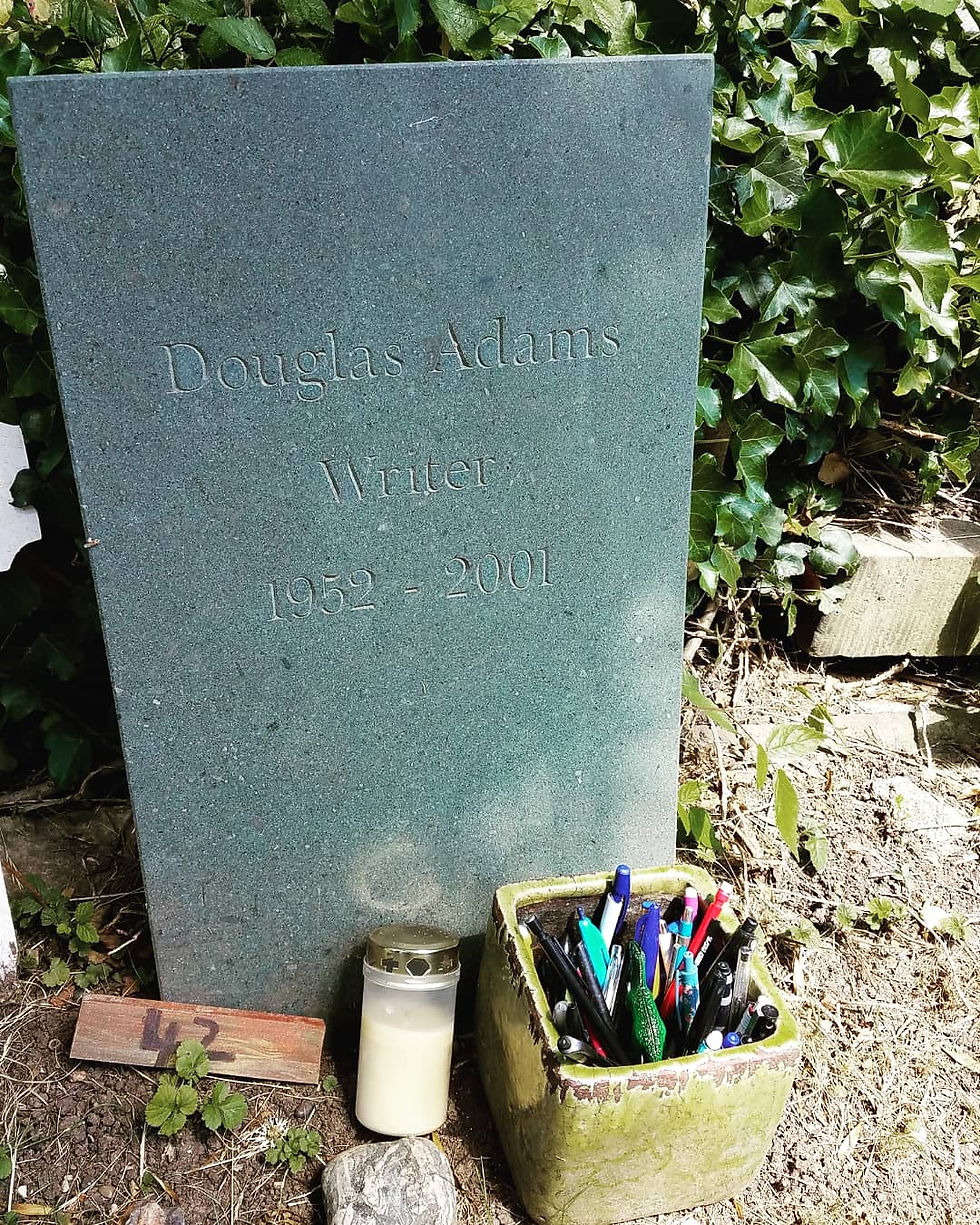
Also, when I was in London, I stumbled across Douglas Adam's grave almost by accident, so enjoy a cool and appropriately adorned graveyard picture:
Attachment by Rainbow Rowell
I think I hyped Attachment up too much in my head. I adored Carry On and Fangirl, so I figured, why not tackle another Rainbow Rowell book? And it was cute, but the whole thing was a little bit underwhelming. I feel like I'm going to be fluctuating back and forth between "it was good" and "I expected more," so let's cut right to the chase and say it was good but not great. I don't know. It wasn't mediocre because it really was a well told, inventive story. I think I just didn't click with it the way I thought I would
The writing was excellent and the characters were real. The idea surrounding the romance was unique too; set at the end of 1999 in a newspaper, where the background fear of what might or might not come in the new millennium highlights the fear of what might or might not happen between Lincoln and Beth. The formatting is brilliant too--half emails between Beth and Jennifer, half Lincoln's perspective. That makes it one-sided with a peek into the other character's mind. We get to witness Lincoln's love for Beth grow, and, like teenage confidants, get to squeal over when Beth mentions him in the emails.
Lincoln was like a strange mix of 'the perfect guy' and 'the guy I want nowhere near me' which is Difficult to articulate. He had all the right qualities--a good heart, a level conscience, a desire for movement and understanding--but it was wrapped a little too neatly. He had flaws, of course, every good leading man does, but perhaps Lincoln and I were too much alike in our fears and faults. Or perhaps he was too hung up on his ex from nine years ago who shares my name. That was a bit offputting, at least for me. But as a character, I was rooting for Lincoln. I wanted him and Beth to find each other and be perfect for each other, and (spoiler alert) I got my happy ending, even if I still wasn't totally satisfied.
Beth felt a little one dimensional in the beginning, but I think that's because we learn about her through Lincoln's infatuation turned to love, and that she was literally just words for a bit. However, by the end, she felt much more real, especially once she made a physical apeparance in the book. She felt more 3-D before that too, and I think part of that is the reader falls in love with Beth along with Lincoln, so her general sense of realness increases as we get to know more about her. I generally enjoyed her emails a little more than the Lincoln chapters.
The story felt like it was for an older audience than her other works, and maybe that's why I didn't Really Love it. I'm discovering that I'm trapped between YA and adult without feeling really pleased with romance in either. The characters are either too old to be relatable or too young to be 'responsible', so my weird early twenties ass is sitting here wondering how on Earth I can make my life more like Friends.

Timekeeper by Tara Sim
This book was a fun adventure. It had the LGBT+ representation I'm always looking for, an realistic magical concept, and, coincidentally, it matched the place I was going! Timekeeper takes place in industrial London, telling the story of a young clock mechanic in a world where time is controlled by clock towers.
Danny struggled with a lot in this book, but one thing he didn't struggle with was his sexuality, which was a breath of fresh air compared to the usual gay crisis present in queer literature. Instead of questioning his self-worth, Danny worried about the repercussions on time and his world should he continue his relationship with the spirit of a clock tower. Colton is enigmatic and naive and immediately drew both me and Danny into his world.
The plot was exciting, with an explosive (literally) mystery to solve and a cast of interesting characters just trying to make the most of the time they have. Danny's search to save his father (and consequently the world) is at times the impossible quest of a desperate boy and other times the trials of a man looking for love. There are twists I didn't expect, and they kept me reading far longer into the night than I should have, especially before days spent exploring London.
Timekeeper was a very unique experience. And while there were times it felt young, it was never enough to get me to put the book down. I truly enjoyed Timekeeper and the world Sim built for it, and I look forward to reading the next book in the series.

Running With Lions by Julian Winters
This was one of those books that I saw all over twitter and tumblr and the spheres of LGBT+ readers and writers, so I knew I had to read it. And, ultimately, I did enjoy it a lot. My standards were really high and I think some of the writing style felt a little too juvenile, but it really reflected the youthfulness and insecurity of the main character, Sebastian. For a debut novel (and even as a book in general), it was very well done. I adored the diversity and representation, especially with how acceptance and respect were upheld in the novel.
I struggle with sports novels, but Lions did really well with handling the heavy soccer elements without confusing the reader. And perhaps I spoke too soon, because I adored the All For The Game series, Running With Lions, and Check Please!, all sports-heavy works, plus the longest of my own fictional creations includes a healthy helping of school athletics. So maybe I'm shifting towards being a sports reader. Or maybe I'm just really into LGBT+ books and some of those also happen to include sports. Regardless, the camaraderie of sports teams is Fabulous and can be used for so much in novels.
The characters, in addition to being diverse, were very real. Teenage boys, especially in big groups like a team, can be hard to deal with. But none of them felt like stereotypes and everybody got some sort of satisfying conclusion.
Sebastian's insecurities felt real too; the childhood trauma and the fear of coming out even with a rather accepting, average family really highlighted the struggle even "well adjusted" teens can have. And I loved his chemistry with Emir. Their history and subsequent future were both interesting and honest. It doesn't take a giant fight or a terrible event to lose touch with childhood friends, but that doesn't mean trust can't be rebuilt.
Sebastian's fear over the future was relatable and I appreciated that he didn't need all the answers in order to finish the story feeling better about his life. Not everything needs an answer, and that's okay.
LGBT+ rep books are gaining popularity right now and I am Living for it.

Ink by Alice Broadway
This was a book I knew absolutely nothing about, both because it doesn't have a real summary anywhere on it and because I got it from a friend instead of buying it myself. And as an exercise in world-building, it was very interesting.
The history of this world was fascinating, but it got to the point where it was wayyyy more interesting than the main character. Leora felt like a generic in a white bread, brown hair "kind of plain but not ugly here's a description of my body" kind of way, which I am Not About. She was also passive until she was forced not to be, and even her ambitions didn't feel...overly ambitious. It was like the author was trying too hard to make her generic while also fitting the mold of the unlikely heroine 'finding out her past is a lie' trope that's way too common in YA literature. Maybe I'm just jaded about the misrepresentation of main female characters in dystopian novels, but overall it wasn't a book I was dying to immerse myself in. The ending kind of dragged a bit and I expected more of a rebellion twist than was presented, so all in all this wasn't the dystopian novel I was expecting. I guess having Scott Westerfeld and Suzanne Collins set the bar makes everything else seem subpar.
There was a very slight romantic introduction that was then blown way out of proportion/grown way too quickly with no build up and very little screen time. There was more chemistry between Leora and her friend Verity than there was with her and the supposed love interest, Oscar. That probably aided in my dislike for the book, since I'm so picky about romance.
There are more books in the series, but I'm on the fence as to whether I want to read them or not. I wasn't very impressed by this book, although it did make want to go get another tattoo, so I guess that's something.

The Girl With the Make-Believe Husband by Julia Quinn
This was. A trashy period piece romance novel and. I loved it. Which is kind of embarrassing, but it turns out I'm a secret romantic. Ironic, considered I just tore down a book for being romantic, but this book did it well. I have standards.
I'm not really sure how to go about reviewing this book, because it's so far out of the realm of normal reading for me, but I'll give it a shot.
Quinn appears to have done a lot of research on colonial America/the revolutionary war, although all of that took a backseat to the fiery romance between Cecelia and Edward. I'm a big fan of amnesia love stories, and this one ticked a lot of my boxes. And the romance, despite being very quick regency romance (or perhaps because of it) was believable, to a degree. There's always a bit of suspension of disbelief with romance novels (or at least I feel like there has to be, simply because the nature of the genre relies so much on instant attraction and a decent amount of love at first sight), so I went in knowing I'd have to read everything with rosy tinted glasses. But I love a promised happy ending, and with the addition of Jane Austen-like time period stuff, I was a happy camper.

The Dangerous Art of Blending In by Angelo Surmelis
I read this book in less than six hours. Non-consecutively, because sleep is a necessary thing and I started reading at midnight, but it got to the point where if I didn't put the book down I never would.
The book was A Lot. It tackles the terrifying topics of child abuse and small town toxic mentality mixed with the bigotry of religion and the strict impositions placed on tradition, especially in a family of immigrants.
I've never once encountered a book that tackled so much heavy material while also providing a love story that wasn't about saving the other person. Henry wants to save Evan more than anything, but they both have to learn that the only person who can save Evan is himself.
Evan spends so long trying to for his life to fit into neat, separate compartments. His abusive mother and her oppressive church community. His repressed feelings for his suddenly very attractive male best friend. His artwork and an unstable future with only the promise that he can one day get out. And Evan wants to get out so badly, even if it kills him.
This was a book about vulnerability and knowing that love isn't love if it hurts you. If they hurt you.
I had a lot of feelings about and during reading this book, and it's difficult to articulate why. I think maybe I connected with Evan's need to hide parts of himself away, to compartmentalize his life so that the edges can't overlap and he can't be a complete picture to everyone. And though I've never faced the terrible abuse that Evan has, everything he did was understandable. He found his own happy ending, despite everything his mother did, despite everything the bullies at school did. Evan saved himself. He had help and support and love from Henry and the Kimball family, all necessary for Evan to know he wasn't alone, wasn't unlovable, but ultimately Evan was the one to save himself. And that took more courage than anything else.
I cannot recommend this book more highly.

Hyperbole and a Half by Allie Brosh
This read more like a blog than a book, which was a neat change of pace after speeding through so many novels. Paired with Brosh's eclectic mix of life stories and childhood memories, her witty sense of humor, and hilarious hand drawn images, this was a book I couldn't put down. Brosh tackles everything from a valid fear of geese to battling depression, all with clever language and cartoonish depictions of her life. And while my overall impression was that I enjoyed reading it, I definitely enjoyed some of her sections more than others, but that happens with collections.
This book was recommended to me by a friend who has battled depression, claiming Hyperbole is "the most accurate depiction of living with depression and also Great Dog Drawings" that she had ever read, and that I needed to read it immediately. So I tracked down a copy and did just that, and while my bout with what I'm hesitant to label as "depression" was very different from Brosh's, her depiction helped me understand what it's really like better than anything I've ever read. Brosh isn't afraid to dig into the weird, nitty-gritty lesser talked about parts of depression, and her blunt depiction of both her suicidal thoughts and recovery really drove home the point that most people really don't understand what depression is like. She tackles a lot in this book, and I oscillated between laughter and stunned silence.
If nothing else, read this book to better understand what the people around you might dealing with. Or for her Really Funny dog stories.

Everything Leads to You by Nina LaCour
I'd never heard of Nina LaCour until I picked up this book for like $4, and now I want to read everything she's ever written.
LaCour has a beautiful grasp on what it is to be young and confused but still growing, and while this was certainly a love story, the rest of the stuff going on made it feel as though that was only a single facet of the main character, Emi's, life.
It's an LGBT+ story with a biracial woman loving woman (wlw) main character, handling great diversity without making it a 'gay panic' book. Instead, we get a brilliant glimpse at the kind of love that movies try to create, which was pretty meta in its own right.
The story starts with heartbroken Emi graduating from high school and working as an intern production designer for a movie. Her brother, Tobi, lets her and her friend Charlotte live in his apartment for the summer before college while he's away, asking only that they do something incredible while they're in the space. And they do, just not in any of the ways they expected. Emi and Charlotte are pulled into a mystery surrounding a letter left by a dead celebrity. And while the mystery keeps them chasing for answers, what Emi really finds is that sometimes the magic of movies comes from the reality behind them, even if it does mean the collapse of the fantasy.
I was a little tired of Emi's sad desperation in the beginning, but then it meant I got to witness her growth, see her move on from her broken heart to find something amazing, and that made it worth it.
LaCour has brilliant descriptions without getting overly exposition-heavy or even particularly descriptive, if that makes sense. She can set the tone with a few things pointed out, sounding like the production designer that Emi is, then lets the scene unfold and speak for itself. It was beautiful and powerful and more than I expected from a little lesbian book I'd never heard of. But I loved it, and if you decide to give it a chance, maybe you will do.

And that wraps up my summer reading list. August should come along right on schedule, but in the meantime I would love to hear what everyone else is reading this summer.
Keep writing, my friends!
Sam
Literary recommendation: Uglies series by Scott Westerfeld
Movie recommendation: Mamma Mia: Here We Go Again (2018) dir Ol Parker
Comments