March Review
- Samantha Gross
- Mar 31, 2019
- 10 min read
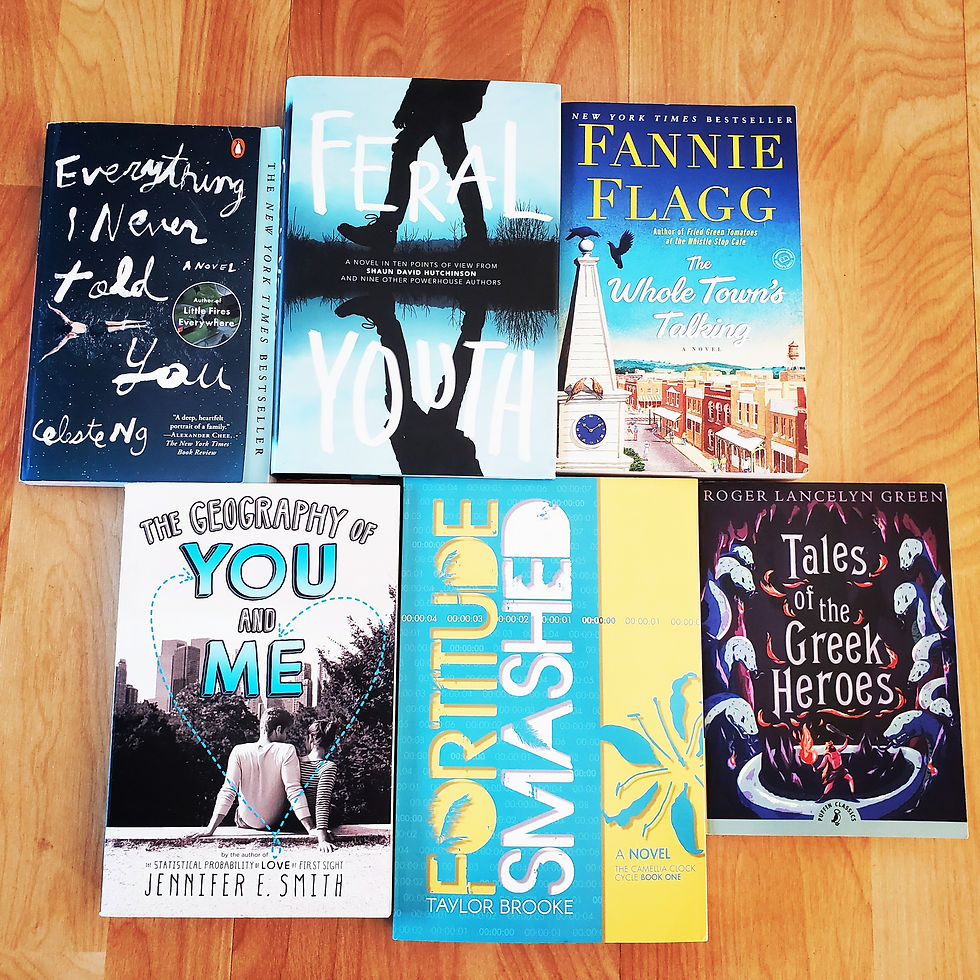
I don't really pick themes for the books I read each month. I think I consciously chose things that were a little more spooky for October, but usually I'll just read whatever I feel like reading next.
This month, though, I finished my second book for the month and noticed that the two I'd read and the one I was set to read next were all blue. So that became the theme for this month; blue books.
The best part is that most of these blue books weren't sad, so the "blue" aspect was entirely physical. I actually ran out of blue books by the end, but luckily I haven't finished the book I'm currently reading (which is very, very orange), so that can get lumped into next month.
So let's get started with my reviews for my month of very blue books:
Everything I Never Told You by Celeste Ng
I went into this book and thinking it would be something similar to Jay Asher’s 13 Reasons Why. It was and it wasn’t, mostly because it didn’t track the reasons Lydia died so much as it built the story of her family, their success, their failures, the why and how Lydia ended up the way she did.
Set in the 1970s in mid-Ohio, Everything I Never Told You follows a Chinese-American family and their mixed race children, exploring relationship dynamics and what it means to take charge of your own life, both before and after the middle daughter, Lydia, is found dead in the lake.
Already a mess, this family is ripped apart and put back together as their worldview shifts and shatters, finding new ways to view and understand one another. Perfect middle child Lydia, bearing her mother’s dreams on her shoulders, doing everything she can to stay afloat. Forgotten youngest Hannah, a child used to living in the cracks, to stealing forgotten things and trying to convince herself she isn’t one of them. Angry Harvard-bound Nath, who is trying to get away, to find a place where he can exist without his father’s scrutiny. A mother who wanted to be a doctor, a father who wanted to be anything but Chinese, this family is built entirely on things they never told each other. Things they can’t even think to describe.
This book took me awhile to get into, and I think that was just because it took time for me to find the rhythm of Ng’s writing style. She’s fond of the metaphor-heavy writing style that I usually like in books, but I suppose she started heavier than I expected. We’re given very little time to get to know the Lees before tragedy strikes, and then all the time in the world after Lydia’s death.
A beautifully crafted portrait of a collapsing family, this novel was a character study and a love letter rolled into one, bearing flaws and raw honesty in a way not a lot of authors are willing to attempt. It was heavy, the more I read about Lydia’s story, Lydia’s impending death, and by the end I felt like I could truly call the story tragic.
I guessed correctly, in the end, about what killed Lydia. But that only made it hard to read, sadder to process. A family of wasted potential, of family members who live in their own orbits for so long they don’t even realize there all each other’s moons. That the things they do for themselves are really things they do for each other, a way of living up to the expectations they have grown to bear.
Overall this was a heavy book to read, one that I’m not sure I would have read without the recommendation of a friend. But I did, and maybe you will too.

Feral Youth by Shaun David Hutchinson and nine others
Some people buy books because they have pretty covers, but I've always been a bit of a sucker for books with neat titles.
Feral Youth was a better concept than the execution. More time was devoted to the individual stories than the overall plot, which left the book somewhat lacking. It facilitated the idea of teens forming connections in the woods, but it didn't quite pull the characters together like it wanted to.
The format was super interesting and very Geoffrey Chaucer Canterbury Tales -esque in that the teenagers stranded in the woods told stories as they worked their way back to camp. Some of the stories I really enjoyed, others I didn't, but it brought together an impressive list of YA authors and created a cohesive project.
What I really liked about this novel was the acceptance of the subjectiveness of truth in fact versus fiction. The teens telling the stories told truths or lies or something in between, but the narrator continued to remind us that it didn't matter where a story fell on our believability scale, just that the person telling the story believed it to be true (or knew it to be a lie). It's a very meta way to look at story-telling, especially in a book like this, where the act of storytelling takes up the majority of the plot.
I liked some writing styles more than others, but the authors all fit together nicely, creating a diverse cast both inside and outside the book. It was definitely an interesting experiment in collaboration, while giving each other a specific opportunity to shine.
I appreciated a lot about this book, to the point where even though I didn't really like all of it, I would still recommend it.

The Geography of Me and You by Jennifer E. Smith
This book was a commentary on human connection and loneliness, the impossibility of location. Owen and Lucy ricochet off each other, sent helplessly in opposite directions, a string of postcards the only thing connecting them. It's a connection forged in a single night under a dark New York sky, and it shouldn't work. But, somehow, after so long apart, after so many miles between them, they find their way back to one another. And it's cheesy fiction, but that feels like love.
I appreciated the lack of unnecessary drama, of overused miscommunication. Lucy and Own thought of each other but they were never all-encompassing obsessions. They were smart teenagers who made decisions based on themselves, lucky enough that those decisions included each other as well.
I loved that this book took us places. Lucy studied in Scotland, London, traveled to Paris, Rome, Austria, finally getting to see the places her parents always went. Owen traveled West, driving through Chicago, Tahoe, learning San Francisco, Seattle, following the steps his parents took together before they settled into life in one place.
This book isn't just about romantic love—it tackles the importance of finding a place to call home, of self-fulfillment, a getting to see nowhere and everywhere. It's about how sometimes a place to call home isn't a place at all, but a person.
Bookish Lucy, looking for adventure outside the pages of her novels, left behind on her parents adventures. Pragmatic Owen, trailing after his grieving father in the wake of his mother's death, seeking home in a place (and a person) that's not there anymore. Together, trapped in an elevator on a night when the New York goes powerless, they find out it's possible to know someone and not really know them.
Yearning for something bigger than themselves is a quintessential human and teenage experience. Smith depicts their teenage hearts and worries with grace, set to the backdrop of the globe and composed a parallels and metaphors. The strings keeping them attached are stretched far but unbroken. Her language is beautiful, a poetic look at two wandering souls, who no matter where they go, they're never lost. They're only just trying to find their way home.

Fortitude Smashed by Taylor Brooke
This book was certainly an original concept, or at least a creative new way of introducing a familiar idea. And it was LGBT, which made it even better in my eyes. Fortitude Smashed is about the idea of fate vs choice and how sometimes those things can collide in the most unexpected ways.
In a world where everyone has their soulmate, their "Rose Road," predestined, each person has a countdown clock to when they will meet their ideal match. Detective Shannon Wurther is the youngest detective on the Laguna Beach police force, walking in his father's footsteps and trying to live up to his own golden boy standards. Aiden Marr, still recovering from the tragic death of his parents years before, is an art thief, wanted in several cities and jumping from one crime to the next. Caught in the middle of his heist, neither Shannon nor Aiden are expecting their timers to go off, and suddenly they're both thrown into chaos, trying to determine how--or if--they can make something like this work between them.
The stark contrast verses the sheer similarity of the characters was incredible. They were so similar and so different, and somehow it worked. They even, spoiler alert, fell in love at the exact same moment. They were both messy in different ways, composed in others, holding each other and themselves together in unexpected ways.
Fate determined they were made for each other and then kept throwing people and situations at them that made it seem like they would never work. Shannon's best friend, Karmen, thought they'd explode, and there were several violent moments that almost tore them apart. Even the way Aiden and Shannon fought in the beginning made it seem like they'd never get themselves figured out. But they were also inevitable, gravitating toward one another and fitting themselves almost seamlessly into each other's lives.
This novel, beyond the obvious tension between fate and choice, also focused a lot on the idea of finding the best and worst pieces of yourselves in other people, and how sometimes they're the same thing. The dialogue between Aiden and Shannon especially jumped into this idea, the way the two of them pushed and pulled, gave and took, trying to decide whether to lie or bare their souls. They were a patchwork of honesty, and it was the best and worst of both of them.
I really appreciated that Brooke made the characters each have their own struggles, their own hurt, and nothing was magically fixed by suddenly being with each other. Neither was more or less messed up than the other, and there was no magical love fix for all their problems. They had to work for their relationship, work to make things right between them, as well as work to come to terms with their own issues. But, the novel also portrayed the gradual acceptance of a support system, understanding that love is support, and how the presence of other people can make it easier to heal.
Also, this book, right away in the beginning, did a beautiful thing. It came with trigger warnings! Without giving spoilers, it warned about things that readers may potentially have issues with and which chapters contained those things, that way anyone who may be triggered by the events could prepare themselves accordingly. It made reading certain pieces of it easier, because I knew what to expect when, just without any of the spoiler details.
Overall, this was a book I consumed in a couple of days. It's a series, but it ended well enough that I don't think I would need to read the next one, but if I were so inclined, I could.

The Whole Town's Talking by Fannie Flagg
This book was recommended to me by an older woman at church and read very much like a letter from my grandmother. Which, while is overall pleasant to receive, does tend to be rambly and overly concerned with things I don't particularly know (or care) about.
A multi-generational story about the founding and subsequent growth of a town in the midwest, The Whole Town's Talking didn't really start until one of the main characters died. From there, the growing residents of the town cemetery continued to exist as they had in life, watching the town and chatting with their neighbors.
The timeline stretched from the late 1800s to 2016, where each decade was marked by who was born and who died. Some pages felt like early bits of the Old Testament, where it just lists out so and so the son of so and so, and other bits felt like a genealogy quiz for a family I wasn't part of. It was exhausting trying to keep track of everybody, and while the overall book was....charming, it ultimately wasn't my genre.
I'll give Flagg this though, she knows how to write a wide variety of characters, both likable and not. Everybody was different and solidly built, mostly more than just a caricature of some small town persona. A few names stayed for a while, and those were the ones I was surprised to find myself kind of invested in. After all, I did read 300 some pages of this book, so something in it had me committed to finishing.
That being said, I wouldn't recommend this book to anyone my age. Or anybody less than two decades older than me.

Tales of Greek Heroes by Roger Lancelyn Green
I read this book in a few hours, although I'm sure if it was because of my interest in the subject matter or because it was sunny and beautiful and reading outside is one of my favorite things.
Regardless, I read it in like three hours (excluding a lunch break) and felt pretty solid about it. Elisa gave me this book from her time in England, and a big factor in my creative writing/reading growth was Rick Riordan's Percy Jackson series, so everybody already knew I'd adore this book.
Because of that prior interest, I already knew most of the stories going in. However, this book connected a lot more of them than I had really known were intertwined, and a refresher was necessary for the stories I'd already known.
Green does a good job of conveying the myths with a straightforward, unbiased style. Which, I'll admit, made the tragedies a little lighter than they were probably intended to be, but also allowed for more growth and understanding on the reader's part. It also made a few deadpan deaths absolutely hilarious.
I can't really critique the overall book content, because myths of any civilization aren't really subject to outside change, so this review will be short. I do wish a few more stories had been included, but Green had a good variety and tied them all together in a cohesive coherent narrative.
Also, don't tell Elisa because I'll never live it down, the cover is really pretty and that makes it a little better.

This month was a bit exhausting, so making sure I had the time to read this lovely variety of blue books was very important. I think reading is a great way to recharge and take time for myself, while also making my poor task-oriented self feel as though I've accomplished something.
It helps when the majority of the books were enjoyable.
Keep writing (and reading!), friends!
Sam
Literary Recommendation: This Adventure Ends by Emma Mills
Movie Recommendation: Captain Marvel dir. Anna Boden and Ryan Fleck
Comments