April Review
- Samantha Gross
- Apr 29, 2019
- 15 min read
There's a crow that sits with me when I read outside. Or, well, that's not right--it sits in a tree in my neighbor's yard, above where I read on the back steps. It's a big crow, and for the most part it just hangs out in the branches, looking around the neighborhood and occasionally screaming. Not very different from what I do, only I have hands to hold a book while I do it.
I think the crow's building a nest. It's spring, after all, which is the time for nest building and egg laying. My neighbor down the street has a little hummingbird nest right beside her front door, with two little chicks inside, smaller than dimes.
Crow babies would be bigger, but not by much. I'm hoping it really is a nest and that there will be babies. Maybe they'll scream above me while I read and my reading in the sun will cease to be a solitary activity. I don't think I'd mind it so much.
The books I read this month don't have anything to do with crows or babies or backyard trees. But they do all have a theme of being alone, of looking for someone to help make sense of the world. They characters aren't necessarily looking for crow companions, but they are seeking sense and companionships.
So let's dive in and see who finds themselves a little less lonely in this big world.
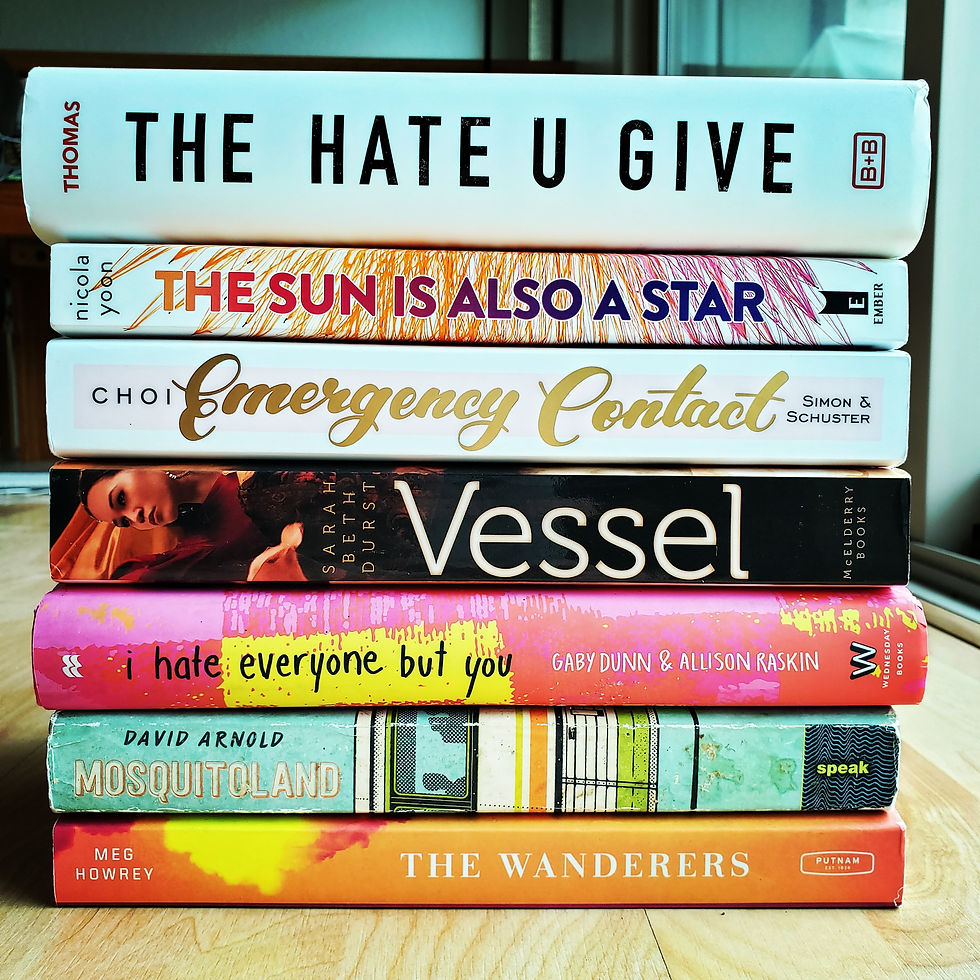
The Wanderers by Meg Howrey
I picked up this book thinking it would be a less scientific The Martian, and couldn't have been more delightfully pleased when I was wrong. There's still a lot of science, like in Andy Weir's book, but more along the lines of things I can understand. Metaphors sprinkled into equations, a language I've learned how to speak.
Prime, an international non-corporate space company, wants to send three cosmonauts on a five-year journey to Mars. Carefully selected for their skills and background, Helen, Yoshi, and Sergei, are given the opportunity of a lifetime: to be the first humans to visit Mars. But before they can take that plunge, Prime wants them to run a seventeen month simulation of what the trip could look like. If it is a success, if they know the team can handle the harrowing journey, they might very well get to see the surface of the red planet.
After a while, though, part way into the simulation, the book was more about people than journey--after a bit it stopped being about three people going to Mars and the ones they leave behind and becomes more about the way humans interact, the way people feel and change, in both the incredible and the mundane.
Told from the perspective of each cosmonaut and one of their respective family members left on Earth, The Wanderers is a look at who we can become when faced with the most extreme circumstances, both outside and inside. Helen's daughter, Mireille, fondly labeled Meeps, has watched her mother's career trajectory from the ground, trying to convince herself that she is more than just the astronaut's daughter. Yoshi's wife, Madoka, wants to believe that the person she is, the person she wants to become, is more than just a mask she hides herself behind, afraid to admit that she doesn't really know herself. Sergei's sixteen year old son, Dmitri, is trying to come into adulthood, come into a stable relationship with his father, come out of the closet, but is afraid of the way he is being watched without truly being seen.
There were so many beautiful parallels between the people going space vs those they left behind: Helen and Meeps recognized the way in which the loved, the depths to which they pretended. Dmitri and Sergei realized that they were both seeking validation, seeking a way to let the other know they cared without revealing too much of themselves. Yoshi and Madoka each came to terms with the person they presented to one another and themselves, and the way they viewed their marriage.
The man who felt as though his father never knew him, trying to convince his son that he sees him, that he knows. A mother who isn't sure how to forge a connection when her heart is light years away, finally understanding that sometimes bridges have to be built in absence and in time. A husband who's surface of self and love is organized and unseen, facing a wife pretending she is something more and something less at the same time.
The astronauts are told they are on a simulation of what their trip to Mars will be like. A practice run. This isn't questioned, by reader or character, until the book is almost over. And then doubt and paranoia start to creep in, making us and the characters question reality, rethink all the things we've gotten to read thus far, now with a new light of is it or is it not. The answer never really given, but the journey is still there, the process still happened, Helen, Yoshi, and Sergei went somewhere and came back changed. And it was more about the people than the journey anyways.
Howrey crafts brilliant comparisons between space and humanity, and her language of both humans and the universe is masterful and well-placed, but also brimming with emotion. It is human to compare, to compromise, to look at the stars, at the planets, and the empty vastness of space and think only of ourselves. It is human to look at the universe and dream.

Mosquitoland by David Arnold
Mosquitoland was a bit of an anomaly. It was simultaneously the most complicated and the most simple book I've read in a long time. Everything from the main character to the journey she takes from Jackson, Mississippi to Cleveland, Ohio was this mixed up mash of predictability and uncertainty, mundane and extreme. It reminded me a little bit of a class I took in college, where we looked at literature under the lense of what is ordinary and what is beautiful. That idea of beauty was distorted rather quickly, though as we learned about the sublime, or something that was so beautiful, so awed, that it was also terrible.
Mosquitoland was that kind of sublime. It was raw, in every sense of the word, and throughout most of the novel I felt as though I was trailing behind Mim, all the while saying, yes, you're not okay, but this probably isn't helping. Mary Iris Malone, the main character also known as Mim, may or may not have psychosis. Her aunt did, so genetics clearly aren't on her side, but her father was a little more paranoid than he needed to be. He was also a bit of a mess, which appeared to also be genetic.
Mim's parents got divorced a year ago, and after her dad remarried he relocated his new little nuclear family to mosquitoland, Mississippi, where Mim and her myriad of health problems (blind in one eye, displaced epiglottis, oh yeah, and potential psychosis) absolutely hates everything. When she finds out her mom is sick, she packs an extra shirt, all the money she can find, and her trusty warpaint lipstick before hopping a greyhound headed north. Along the way she meets a cast of unlikely characters and facing some unnerving truths about herself, the world, and the people that live within it.
A teenage girl traveling over 900 miles alone made me nervous. And right from the start she was tracked by one of the worst kinds of men. But a crashed bus, an old lady with a mystery box, a boy with down syndrome living in the woods, and a young man trying to find his sister are only pieces of Mim's journey, miracles and mishaps and things that make her realize maybe the world is just as terrible as she thinks it is, or maybe it isn't. Maybe villains have good streaks and heroes have faults and maybe sometimes the people we think are one turn out to be another.
Arnold gives Mim a fantastic vocabulary and a vivid imagination. She's cynical and funny and insightful when it suits her. Arnold drops phrases throughout the book, weaving in bits of power that had me reeling. He also handles Mim's emotional responses in a complete and tactful way. Her sexual assault is given a reaction that fit her character, and her angry teenage outlook is both justified and dramatic, as every teenager (former and current) would agree is fairly accurate.
Overall, Mim's change was monumental in small ways. Admitting things, recognizing the way other people can't be put in little boxes, that loving is something that's allowed to be complicated, but also allowed to be simple. That sometimes it can be both at the same time.

I Hate Everyone But You by Gaby Dunn and Allison Raskin
This book was an exercise in anxiety. It feels like I say that about a lot of books where friendships being tested are main conflict, but it’s true. My tiny confrontation-hating heart can’t handle witnessing arguments, whether they’re real or fictional.
The characters were a mess. And, I mean, they’re college freshmen, I was in this too, but they seemed unreasonably messy, at least by my standards.
Studying at schools on opposite coasts, best friends Gen and Ava regularly send each other emails and direct messages to ensure they keep and touch and try to navigate this new life they both live. Cue drama about college classes, sororities, dumb boys (and girls, there is bisexual representation, thank you Ava), and a friendship that is probably too dependent to be healthy.
Gen was too self-sabotaging, blinded by short term enjoyment, and lacking introspection or empathy. Ava was overly dramatic, emotion-driven, dependent, and controlling. By halfway through the book I wanted to strangle both of them. Ah, young adulthood.
The formatting of the book made it difficult to tell between the two characters, and there were several instances where it had to double back and reread a section to remember who was talking. Or who was who. Maybe I’m being too critical, especially about a book I got for $3.00, but what’s the point of writing book reviews no one will read if I can’t be brutally honest.
That being said, there were several lines in this book that many physically laugh out loud. The co-authors are witty and clearly get along well if they’re able to write a believable friendship this well. I was impressed by the way they encapsulated the ‘first year of college feeling/ in two very different and very real always. So, there, I said something positive.
I think what frustrated me most is that this book had the format of several popular books from a middle school years, but the with the more mature subject matter of college, and I didn’t love it or think it was particularly good. The characters were hard to like most of the time, which made it hard to commit to the story. Ava was always the one who had to apologize even when it wasn’t her fault and that was frustrating. Gen was a bit of an enabler, but only because she was so blasé about her own life, that unless it impacted her in some way she didn’t seem to care. And I suppose we can give them some slack, since there’s at least five years of friendship we don’t get to see prior to the story, but still. I wasn’t super impressed with the way they handled most (ALL) situations.
Read this book at your own peril.

Vessel by Sarah Beth Durst
It took me nearly a hundred pages of this book to get into the story. The descriptions were a little heavy-handed and the world building required a lot of explanation. I did eventually start to feel compelled to keep reading, but by the end everything felt a little lost again.
Liyana wasn't inherently likable from the beginning. Noble to the point of being almost personality-less, it took moments of extremes to reveal her true character. A girl of practicality and stubborn survival, Liyana grew on me, especially with her honest assessment of the people around her. She grew from blind devotion to self-confidence and reliability, maintaining her beliefs and still finding it within herself to wear leadership with confidence.
The other characters grew more likable as time went on, though there was an unexpected romance at the end, which felt like it came out of nowhere. It did fix a lot of problems, so to speak, without feeling too much like a deus ex machina, although there were actual gods that showed up to fix everything, ironically enough.
This was a story that had enough travels, introductions, and mini stories that it could've easily been a series. Everything moved quickly to keep it within a single book, so it felt forced at times, but I'm not sure I would've kept reading multiple books, so maybe a single novel was a better idea.
I'm still very on the fence about whether I liked this story or not, so a review is a little difficult. Durst created a world that was a lot more fluid in it's death and life, a creative exploration of self and what it means to be two people at once. Intention versus fate, in a way.
Liyana was meant to die, born to give up her soul so that her body could be the vessel for her clan's goddess, Bayla. At the ceremony, Bayla never arrives, and Liyana's clan exiles her. Left in the desert to die, she's approaches by a god in a young man's body, who claims the gods and goddesses have been stolen and he needs her help to rescue them. Thus begins a journey across the desert, where Liyana learns more about what's she's capable of--and what the gods haven't been telling them--than she ever thought possible.
It's a compelling premise, and I think by the end I was impressed with how Durst handled it. A lot can happen in stories with questions of agency and free will, what a sacrifice means if it's given or taken. Even when I was skimming over heavy descriptions, the story was compelling enough to continue, at least to the end of this story. There weren't very many powerful scenes or particularly gut-punchy lines, so it wasn't an especially empowering or emotional book. But overall, it was a story I consumed, and I don't think I mind reading it.

Emergency Contact by Mary H. K. Choi
This was a book where the characters were the plot, and because Penny and Sam were absolutely fantastic it worked.
Dialogue, both in person and via text--there was a lot of mixed communication (emails, writing, texts, talking) and all of it was written with media consciousness and clear character voice. I very rarely had to check whose pov the chapter was in, each character voice was clear. They had similarities, spoke fluent one another, but were easy to tell apart. Different interests, but deep down there were pieces of themselves that were so similar. A kindred soul.
Individual plot lines, didn't fix each other, but the whole text, their building relationship, wss a study in how important having a support system is, how just having someone listen and encourage you can be life changing.
Penny and Sam were both in complicated relationships and are struggling with mom problems when they meet. It's awkward and kind of terrible and they're picky with people, but somehow they end up texting, acting as one another's emergency contact when they felt like they were drowning.
Their relationship grew from there, and I could physically see the growth in both characters, like all they really needed to be okay, to find a way to fix the other things in their lives themselves, was to know they had someone in their corner. They told each other things that they told no one else, and it really sold the idea of an emergency contact.
Choi's handle on language and characters is incredible. She was completely in her character's heads, had a mastery over dialogue and storytelling. Penny told stories with the epilogue first, but Choi dropped clues along the way to create backstory and present story beautifully.
Sam's desperation and Penny's pragmatism, combined with their loneliness and fierce creative nature built a world where the two of them are fighting to find themselves and create something worthwhile, both in themselves and in their creative work. Sam was a broke filmmaker afraid to create, living above the coffee shop he worked at and Penny was a college student taking her creative writing courses an hour away from home, both of their single mothers people they couldn't understand. And only small pieces of that changed; Penny finally talked to her mom, Sam finally started to film, and while they were instrumental in each other's change, they weren't a magic cure all. You can't fix your life with one person, but one person can help fix your life. Sometimes all you need is someone to call when you're facing a crisis. Sometimes all you need is an emergency contact.

The Sun is Also A Star by Nicola Yoon
This book was heartbreaking in the best way. I'm usually very critical of love stories, especially ones about straight people, but this was something more. It didn't hurt that it had great representation, and a lot of the problems that Natasha and Daniel encountered were rooted in their respective cultures. I'm tired of "white people falling in love"--I'm Very Here for interracial love stories, especially when the characters and plot line are as fantastically developed as these.
This book was an exploration in relationship dynamics; romantic, sibling, parent and child. The complicated ways we love one another and ourselves. Or the complicated nature of how we hate each other and ourselves. It tackled the idea of race in different cultures and relationships, as well as racism within non-white communities. It looked at fate versus choice and the regret we face when it comes to the choices we've made and the path we feel we've been put on.
The Sun is Also A Star is woven with beautiful metaphors and language--Yoon utilized scientific facts and definitions in fantastic poetic ways. I'm a sucker for space metaphors and the title of the book being dropped casually within its pages.
The point of view and storytelling in this book was fascinating. We saw most of the story through Daniel and Natasha's eyes, but occasionally we were shown people along the way--Irene the security guard, Natasha's father, the immigration lawyer and his paralegal. The text included histories, both for people and for things (eyes, theories) that provided background within the text. These little snippets of other were both things the characters knew and didn't, things that built little stories off the main plot, added to the themes of the story. Whether or not they were incredibly relevant or seemed barely important at the time, they were little gems within their story, weaving together the day Daniel and Natasha spent together. The timeline of the story is interesting too--a book told over the course of a single day, a day that feels like forever and no time at all at one.
The Sun is Also A Star told the love story of two people who were very different on the outside--Jamaican versus Korean, pragmatic versus dreamer--but with souls seeking something to save them, to change fate. They tried to fight their supposed destinies only to fall prey to the inevitability of their lives coming together, poetic coincidences and things that make me believe in love the way Daniel does, the way Natasha learns to.
The end (spoiler alert) is bittersweet but gives a glimpse into possibility. It doesn't tell us exactly what will happen every day, what will carry them to where they want to be, but it tells us that something will happen, that something will always happen.

The Hate U Give by Angie Thomas
I finished reading this book the day of the hate crime shooting at the Synagogue in Poway. I found myself tearing through the last fifty pages at 1am, trying to find an ending, a justification, something.
But white supremacy and hate crimes are still here. Pain and suffering is still here.
People are still dead.
I went to lunch the next day with a friend and had a long discussion about hate in the world, and I cried. I cried because this book was published in 2017 and there's a list of over a dozen names listed in the back, a list that has only grown longer as time has gone on. I cried because this book came out two years ago and violence like this is still happening.
There are important things white people can do to support people of color, and sometimes that means using our voice. Other times it means just listening.
This book was difficult to read, because it forces the reader, it forced me, to confront truths that can be uncomfortable. And that's important, because change doesn't happen when people are comfortable.
Beyond the impactful aspect of the narrative, there's also a great family story, a look at toxic friendship, the danger of the dual nature of outside perception, and the recognition that sometimes even when you speak out about injustice, the world doesn't always listen.
Thomas writes from a perspective that I can't even properly imagine, a life so different from my own that it almost felt unreal. The neighborhood Starr lived in felt like something out of a gang movie, which really goes to show both my own privilege and ignorance. The reality she, and many real life people face, is something I only witness in movies. But violence is real, death is real, and confronting it in fiction only makes the reality of it more stark.
The Hate U Give is about more than a shooting. That's just the catalyst for Starr. It's about the things we do for family, the way we look at ourselves versus the way we let the world see us. It's bout a family that loves each other more than anything, that even in a time and a world that wants to tear us apart, there can be love and forgiveness and hope. It's about bravery in the face of trauma, both public and personal. It's about using your voice for something important. It's about kids growing up fast because the world looks at them differently.
The Hate U Give is about a girl just trying to have fun with her friends, and how the world makes that nearly impossible.
It's about recovering from sadness, from anger, and still dancing, still having fun. It's about how doing those things doesn't make your voice any weaker.
As a white person, my voice doesn't really belong in a narrative like this, except to support people of color and the victims of gun violence. And as a white person, reading The Hate U Give provides a glimpse into a perspective I wouldn't otherwise get to see. Black voices and truths outside the sphere of white space, told from a young woman caught between two worlds, trying to find the courage to speak the truth.
Because the truth is important, and may very well be our best defense against the growing darkness in the world.

Keep writing, friends.
Sam
Literary Recommendation: Six of Crows by Leigh Bardugo
Movie Recommendation: Shazam! dir. David Samberg
Comments