May Reviews
- Samantha Gross
- May 31, 2020
- 17 min read
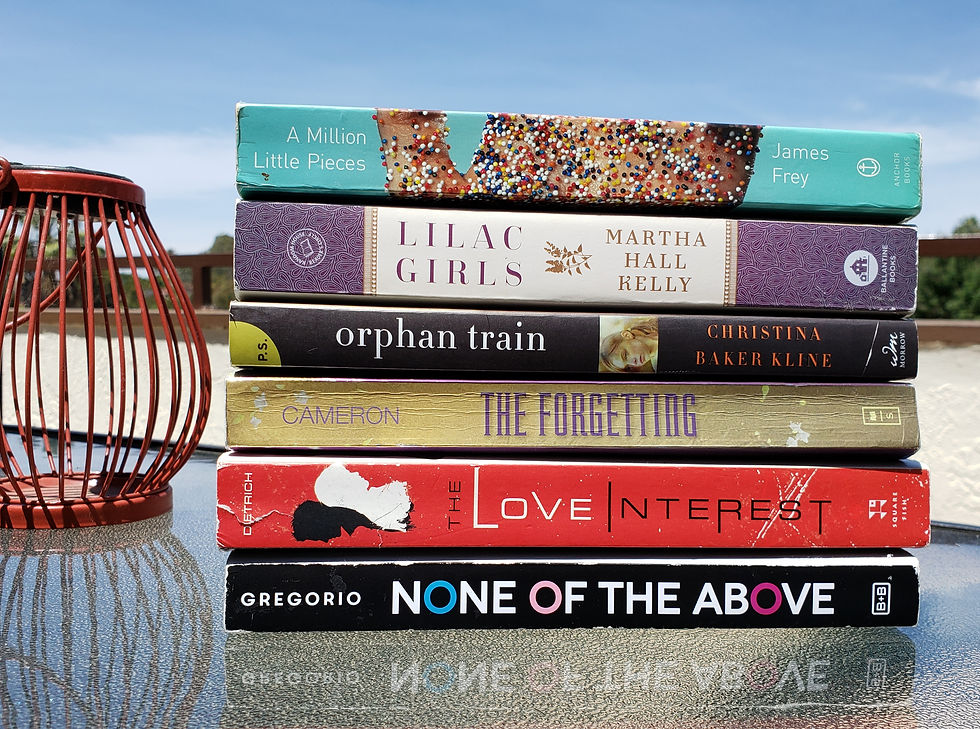
May was a rough month for a couple of reasons. I went back to work, COVID-19 continued as my state started to reopen, and most recently, the rise of protests against racial injustice and police brutality swept across the country. I've been spending a lot of time running and even more time reading, trying to find ways to cope with what feels like the world falling apart. I've also been researching ways to educate myself and find more ways to help, and I'd recommend that everyone do the same. While doing that, it's okay to take some time for yourself and read a book or two. Maybe you'll choose to read one of the books I read this month. Let's get started:
None of the Above by I. W. Gregorio
I had a hard time with this book, but that in no way had to do with the subject matter. The topic of intersexuality was discussed sensitively and it was clear that the author did a lot of research regarding the subject. My frustration stemmed more from the character interactions, and that's probably because at some point I realized I was reading this book with my writer brain instead of my reader brain. More on that later.
Krissy is an average high school senior. She's on the track team and has a scholarship to her dream school, a boyfriend she loves, and she was just voted homecoming queen. But after a rather disastrous homecoming night, Krissy takes a trip to a gynecologist, who makes the discovery that Krissy is intersex. Suddenly her whole perception of self is shattered, and when her diagnosis is leaked to her school, Krissy's world starts to crumble. She'll have to figure out how to face the world when she's not sure how to face herself.
Intersex, as described in the book, is an umbrella term for a variety of chromosomal presentations. Krissy was an intersex female, outwardly presenting as female, but with a Y chromosome. She has no uterus or ovaries, and a pair of internal gonads. I'd never read a book with an intersex character before, let alone a main character, and while I can't let a single book dictate my understanding (further research required, folks! Multiple sources!), this seemed like a decent jumping off point for understanding the intersex community. So I won't really form an opinion about the accuracies of the book until I do more research, but from an outside perspective, it was handled in a decent introductory way.
There's a lot of bullying, transphobic, and homophobic language in the book, most of it directed at Krissy by ignorant xenophobes, but some of it used by Krissy herself as she navigated the world of language and understanding her new reality. Krissy was given a lot of resources by her doctor, information about support groups, surgery, options she had moving forward. Her original doctor definitely broke the news wrong, using the outdated word 'hermaphrodite,' which I firmly believe caused a lot of harm to Krissy's self-perception and how she explained intersex to other people.
Some preliminary research showed that Gregario is a doctor, and while she's not intersex herself, she has treated intersex patience and has experience on the research side of that community. From an outside perspective, I was impressed with how she handled writing the book. In fact, most of my complaining about this book is going to be about the character choices and interactions. Krissy was very hypocritical when it came to her friends and her reactions to their (spoiler alert) perceived betrayals. I was also absolutely ready to throw hands with her boyfriend, Sam, despite him having a great name, and ultimately I'm blaming him for a lot of the things that went wrong with Krissy's outing and subsequent decisions. I was also not big on Gregario's decision to (more spoilers) put Darren and Krissy together in the end. I thought she needed a friend more than another boyfriend and would have liked to see their relationship grow as something other than romance.
I also thought the Josh situation was handled clumsily, and I ultimately thought it was unnecessary. But I think all sexual harassment or assault scenes, whether or not they're called or recognized as such, are unnecessary. I can recognize the importance of talking about sexual assault, especially in the LGBTQIA community, who are perpetuated by that kind of violence at an incredibly high rate, but I just. I don't know, I'm tired and ready for stories or recovery rather than depictions of the attack. I want to celebrate the healing process and character recovery, and the scene in this book felt too close to the end to give Krissy the time she deserved to process and recover. A lot of this book was Krissy avoiding her diagnosis instead of processing and recovering, and I really would've liked to see her grow in that regard. I know I'm not owed that sort of story or recovery proof or whatever by any real intersex people, but I sort of feel like the purpose of storytelling is to bring about healing or give readers the opportunity to learn and grow with the protagonist, and I just didn't get there with this book.
Certain characters in this book felt two-dimensional and the handling of certain important scenes felt abrupt and incomplete to me, but, again, a lot of that is because I got caught up in my writer brain. I try not to read too many books with my writer brain, because instead of actually enjoying the narrative I start rearranging sentences (or sometimes rewriting them) in my head, deciding how I would have written the story. Which, like, it's not my book, so I shouldn't be doing that, but every so often I get caught in it and can't stop. Whoops.
That being said, this was an interesting book, more so for the informative aspect of it than the actual storytelling, but if you're looking for a place to start learning or a different sort of high school story, you can give this one a try.
Similar to: Symptoms of Being Human by Jeff Garvin and Beautiful Music for Ugly Children by Kirsten Cronn-Mills

The Love Interest by Cale Dietrich
What initially drew me to this book was actually a completely different book by the same author. The Friend Scheme won't be released until later this year, but I was so in love with the concept that I found the author's debut book and ordered that one in the meantime. And while The Love Interest wasn't perfect by any means, there were a lot of things about it that I really liked.
Caden is an unwilling member of an organization called the LIC. They raise children from a young age to become the perfect spies: Love Interests for people deemed important, a way to keep tabs on future information from a trusted source. Caden is a Nice, the perfect boy-next-door archetype, and he's competing against bad-boy styled Dylan, a Bad, for the affection of super genius Juliet. But the harsh truth of the organization is that anyone who isn't chosen is killed, so this contest is literally life or death, and Caden wants nothing more than to be free from the place that's made him be everything but himself. But then Caden starts falling for Dylan, and suddenly there's a whole lot more than just one of their lives at stake.
The story as a whole, but especially the end, felt a little bit rushed. Maybe I'm not meant to read action sequences because I so often get lost or distracted when reading the scenes and then blame the book when it's over. Maybe it's me. Regardless, it felt rushed but I loved the concept. That's what really got me into the book; the enemies to friends to lovers secret spy love story. It's like Mr. and Mrs. Smith buy gay (I have never actually seen that movie so I have no idea if that's a correct comparison). I was absolutely losing my mind over this concept at one point, and I still think it's brilliant, but there are parts of the book that didn't really live up to the hype.
I wasn't big on some of the ways the directions the book took toward the end. It felt a little bit like Dylan's rejection of Caden when he thought he might die was just a way to keep the suspense going. Which, isn't a terrible trick or anything, but it felt like a weird character choice coming from Dylan, and it turned me away a bit from them as a couple. Even at the very end (spoilers) when they end up together, Caden makes a comment about how they can't leave each other after being through all the shit they had, and it just felt unnecessarily grim and weird. The back and forth about whether or not Dyl liked Caden just felt unnecessarily dramatic, especially since the book became a 'shut down the bad organization and face a lot of violence' story very quickly. The violence and organization stuff was introduced at the beginning with the Stalkers and the incinerator, but there felt almost like there was a disconnect between the scenes written in the LIC and the scenes with the high school falling in love drama. There were moments when I really would have liked to see more of what Caden did to balance everything, which felt a little lacking. Caden sometimes felt one-dimensional, since there weren't a lot of moments where he got to express interest in something other than Nicki Minaj, Dylan, and staying alive. Some of the dialogue felt a little stilted and awkward too, though I suppose that's part of the game. Nobody is smooth all the time, and really both of these boys aren't as smooth as they thought they were. The awkwardness of the scenes sometimes made them even better, because it felt more real.
In fact, I loved the scenes with Dylan and a lot of the banter with Juliet. Caden working out his feelings for Dylan was probably my favorite part of the book. I loved the confusion and regret in Caden's mind as he tried to work through choosing to be his own person and risking death or not letting the boy he has feelings for die. Caden's inner turmoil over pretending to be someone else for Juliet was great to read. There was a lot about this book I really enjoyed, and most of it was squarely in the middle of the book. Parts of it felt a bit like fanfiction, which is not a bad thing at all, and overall Dietrich is a compelling writer.
I also, as previously stated, love the concept of this book. It was like reading a meta YA novel sometimes, with the set pieces to make the boys look like heroes, the modifications to make them more conventionally attractive. An artificially crafted love triangle, especially one where it defies conventional relationships at the end? Incredible. I may be a bit nit-picky about this book, but the overall idea was a lot of fun and well-crafted (for the most part).
Similar to: Running with Lions by Julian Winters and Autoboyography by Christina Lauren

The Forgetting by Sharon Cameron
Oh man, oh man, I had no idea what to expect of this book and it defied any expectations I had. From a fantastically original concept to a truly surprising and twisty narrative, I was clinging to the last few pages of this book with white knuckles.
Every twelve years the residents within the walled city of Canaan forget everything. Who they are, who their family is, where they are, everything is wiped clean from their memories. For this reason, everyone in the city carries a book on their person, where every day they write down their life in the hopes of reminding themselves of who they are supposed to be. But not everyone forgets, and Nadia remembers everything; her father abandoning her family, the people who claim to be people they aren't. Nadia spends her days quietly watching and climbing the wall around Canaan, until Gray appears, demanding she take him with her over the wall. Together, they make discoveries about Canaan's history (and themselves), things that someone would kill to keep secret. They're running out of time before the next Forgetting, and Nadia has to find a way to reveal the truth or risk losing everything she loves.
It did, admittedly, take me a couple chapters to really get into this book. But once the mystery picked up and I started to better understand Nadia's emotional state and stake in this, I almost couldn't put it down. I quite literally burned myself sitting outside reading today because I just wanted to get through one more chapter (whoops! Wear sunscreen, kids!). What starts as an almost dystopian teenage love story becomes a true story of rebellion and futuristic history. I was drawn in by both the romance and the mystery, which is not super common for me.
Nadia as a narrator is fantastic. She's got this beautiful inner monologue and a quiet demeanor, so that we as the reader get to see Everything and Know all her thoughts, while those around her aren't quite so privy to all that knowledge. But with that quiet observation comes the surprise; Nadia spends so much time being sure of her thoughts and herself that when she is revealed to be wrong, we the audience are also floored, because we were so sure that we (and Nadia) put the pieces together correctly, only to find the true fit is obvious but so very different. Gray was a great foil for that, catching the things Nadia doesn't say, the things she doesn't see. They relationship was genuinely fun to watch progress.
The concept is absolutely brilliant. A city that consistently forgets as part of their history? A girl who doesn't forget and must live with her father's betrayal and the collapse and rebuilding of her home, all while pretending she doesn't remember? Absolutely captivating. And it just kept getting more complicated and twisty, revealing bits and pieces slowly and then all at once, so that we can be the ones to put the pieces together that have been dropped like breadcrumbs for us from the very beginning.
This is a dystopian revolution done differently. It blends genres so well that I didn't even notice until I looked up (utterly terrified and googebump riddled, I might add) to realize I had been led somewhere unexpected. Cameron writes the character familial dynamics and interactions with so much emotion and has crafted a world where the truth is almost more unbelievable than the lies within the city walls.
If you're looking for a unique read, give this one a try. I guarantee you won't see it coming.
Similar to: Annihilation by Jeff Vandermeer and The Wanderers by Meg Howrey, as well as a bit like The Hunger Games by Suzanne Collins

Orphan Train by Christina Baker Kline
This was a fascinating read as well as a pretty quick one. It took some time to get into, which is apparently my theme for right now, but once I got into the story I was Hooked.
Orphan Train tells the story of two young women. Niahm, an young Irish immigrant who lost her family in a fire not long after coming to New York in 1929, is sent on a train to the midwest, where at nine-years old she and many other orphaned children have a chance at, if they're lucky, being adopted by a family or, with higher odds, worked as free child labor for the people supposed to care for them. The other narrator is Molly, a seventeen-year old Penobscot Indian living in foster care, trying to forge her own identity in a world that seems insistent on telling her she does not exist. These two cross paths in a community service project to clear our Niahm, now Vivian's, attic, where the two learn they have more in common than they thought.
I loved the dual storytelling of this book, especially since it spanned decades, going between Vivian's trip on the orphan train to Molly's current foster home, those two things similar but also so different, especially given the time periods, with Niahm/Vivian in the 1920s and Milly in 2011. The two stories were woven together beautifully, and they both with their own merit and worked so well as comparisons to one another. I love a good parallel and this book had them in spades.
Clearly a lot of research went into creating this book, since it was based on real events, and the topic was fascinating. I love learning about the things that shaped generations, things that have been swept between the cracks so that history can make itself feel better about the terrible things it forced on people.
The characters were interesting, but I think I liked Molly a bit more for her spark and vivid personality. Vivian was a great character to follow too, and I wanted her to succeed, for sure, but the historical intrigue was there much more heavily than character attachment in the beginning. Vivian was a little flat at times, but part of that was probably the first person POV, where so much of her was suppressed to become the child everyone else needed her to be, and then the adult who, after facing so much trauma and loss, didn't know any other way to live. Molly's chapters were told in third person, which I think gave her a little bit more elusiveness in her story. She was still growing, still figuring herself out, compared to Vivian's first person, telling a story she already knows.
This book also dealt with a lot of the different kinds of trauma that exist. Vivian's childhood is rife with misfortune and with small spurts of kindness. One instance left me furious and reeling, when she was sexually assaulted at ten and the adults in charge brushed it aside. I was ready to throw hands with those stupid men, both the pedophile and the denyer, holy shit. I think I had to put the book down for a second when they happened, both the get through the description of the assault and to calm down after the infuriating man showed up. Vivian deserved a nice childhood and was made to live through a bunch of shit instead. I also teared up during the chapter about world war 2 and the loss Vivian faced. I was heartbroken for her and all that she'd been through, the happiness she'd been trying to find for years taken away.
I appreciated the friendship that developed between Vivian and Molly, who, through decades of difference found themselves in similar circumstances, becoming what each other needed to find peace and growth. Found family is one of my favorite tropes and it played out so beautifully in this book. If you're looking for a book with an interesting history and fascinating characters, this book fits the bill.
Similar to : Before We Were Yours by Lisa Wingate

Lilac Girls by Martha Hall Kelly
This book was recommended to me by a stranger several years ago, and I just sort of happened upon it recently. I figured I'd give it a go, and while it was a little bit rough at times (geared for somebody a bit older than me, perhaps? Or I still prefer the YA genre so it just felt that way?) I did ultimately enjoy the story.
Lilac Girls is a story told in three perspectives: Caroline Ferriday, a former broadway actress working at the French embassy in New York during World War 2, Kasia, a Polish girl who joins the Polish underground and is sent to Ravensbruck, an all-women "workers" camp--aka concentration camp--, and Dr. Herta Oberheuser, the only female doctor working at the camp, and the one who performs inhumane experiments on the girls. Based on true events (and the real stories of Caroline Ferriday and Herta Oberheuser), Lilac Girls follows these women from 1939 to 1959, through the events of the World War and the search for justice that followed, as each of them tries to come to terms with her place in the war and the world.
Something that I didn't understand about this story and then really liked as it went on, was that the book didn't end with the liberation of the concentration camps and the freedom of Paris. It continued telling the story of these women for over a decade after the war ended, because their story didn't stop with a liberation. Kasia and the other women experimented on, Rabbits as they were called, had to live with the trauma and the physical pain of the surgeries performed on them, and that went on far longer than any war. Kasia survived and had a family, processing her trauma as she went, finding triggers and guilt in things she couldn't control. Catherine's work to gain reparations and help for the Rabbits didn't happen until a decade after they'd been freed from the camp. This was a long book, nearly 500 pages, but it needed almost all of them for the two decades that the story spanned.
The overlapping points in the story were neat as well, with Herta and Kasia the most obvious. Caroline took some time to get into their story, but she played a key part once she arrived. I feel a bit bad because I thought Caroline's perspective was so boring for most of the book, but she served to be a normalizing factor, proof that the world was not as terrible as what Kasia endured, what Herta enacted. I appreciated her more at the end, when she and Kasia finally came into contact. I was admittedly, tired of her relationship with Paul and all the weirdness that entailed, but I'm sure their romance would be enjoyed by other people reading the book.
I also started the story with a lot of pity for Herta. She was a woman trying to survive in a male dominated world, facing sexual assault from a family member and the damaging ideology of a Hitler-led Germany. She came to the camp desperate for money, but as soon as she began to justify her cruel actions, as soon as she started working at the camp, my pity disappeared almost entirely. There were moments of humanity in her, places where I could see the person she could have been, had Germany and Ravensbruck not made her a monster, but by the end even those little pieces had begun to disappear.
There were places I found myself skimming a little bit, mostly over descriptors that went on a little too long or moments that didn't seem to matter in the long run, and it really took me a decent chunk of the way into the book to get super invested, but by the end I was in it. Kelly obviously did a ton of research for this book, and in fact there was a bit at the end that included pictures from the real Rabbits and the camp of Ravensbruck, as well as Kelly's story of all the places she traveled to learn more about these women. I was impressed and a little bit jealous over all the places she went and the things that she learned. Kelly pulled no punches with these characters and the situations they faced, so if you're looking for a book that tackles the honest horrors of the holocaust and world war 2 for these women, give this book a try.
Similar to: The Storyteller by Jodi Picoult and The Guernsey Literary and Potato Peel Pie Society by Mary Ann Schaffer

A Million Little Pieces by James Frey
If I'm being completely honest, I haven't finished this book yet. But I wanted to include it in this month's review group because there's a good chance I won't finish it until July, since I'll be dedicating June to other books.
A Million Little Pieces is the memoir of an addict in recovery, detailing the gruesome and difficult journey toward sobriety. Twenty-four year old James Frey woke up on an airplane with a hole in his face, a black eye, missing two front teeth, and with no memory of how he got there. An drug and alcohol addict for over ten years, James arrives at a clinic in Minnesota with the prognosis that he either get sober or his body will give out before he's twenty-five. James must then decide if he's willing to save himself with a painful road to recovery or let his addiction kill him.
This is a Super Rough story. Frey pulls no punches when describing his recovery, both in the physical thralls of withdrawal and the emotional requirements for surviving his recovery. He goes into graphic detail for everything, from describing the substances he abused to the way his body reacted both to those substances and sobriety. He arrived at the clinic a broken young man, and he stays that way for a very long time.
The characters in the book, real people with real stories, both aid and delay James' recovery, and the realness of it all makes it difficult to read sometimes, because we're confronted with the idea that this story, James' story, and the people in it, are real. We do have to keep in mind the ideas of 'unreliable narration' and the selected memories included in memoirs, because in telling a story, human nature is to select the pieces that make sense and guide the story accordingly. That is not to doubt Frey's story at all, but to keep in mind the human condition as we read. The people in the memoir are real, and perhaps they'd tell the story a little differently, but the end result is still Frey's path to sobriety.
The formatting of this book is very strange. Frey uses no indentations or quotation marks, making the whole story feel like a continuous paragraph of internal thoughts. Sometimes it's difficult to determine who is speaking or if anyone is speaking at all. It makes everything feel mottled and confusing, which both adds to the uniqueness of the story and to the overwhelming nature of the events within it.
Since I haven't finished this book yet I can't really make a recommendation for it. But it was lent to me by a friend who I love and trust, so if she thinks I should read it, then I'll go ahead and say it's a book that should be read. I will ad, however, that this is not a book for the faint of heart. It's loud and graphic and gross, but so is life.
Similar to: Extremely Loud and Incredibly Close by Jonathan Safran Foer with it's sometimes strange formatting, but otherwise unlike any book I have ever read before

Next up is pride month! Pride parades and events might be cancelled, but that's not going to stop queer communities from being loud and proud this month. I'll be reading the rainbow again this year, celebrating queer authors and stories all month long. So I'll see you all next month.
Keep writing, friends!
Sam
Literary recommendation: The Hate U Give by Angie Thomas
Media recommendation: Orpheus by Sara Bareilles
Comments